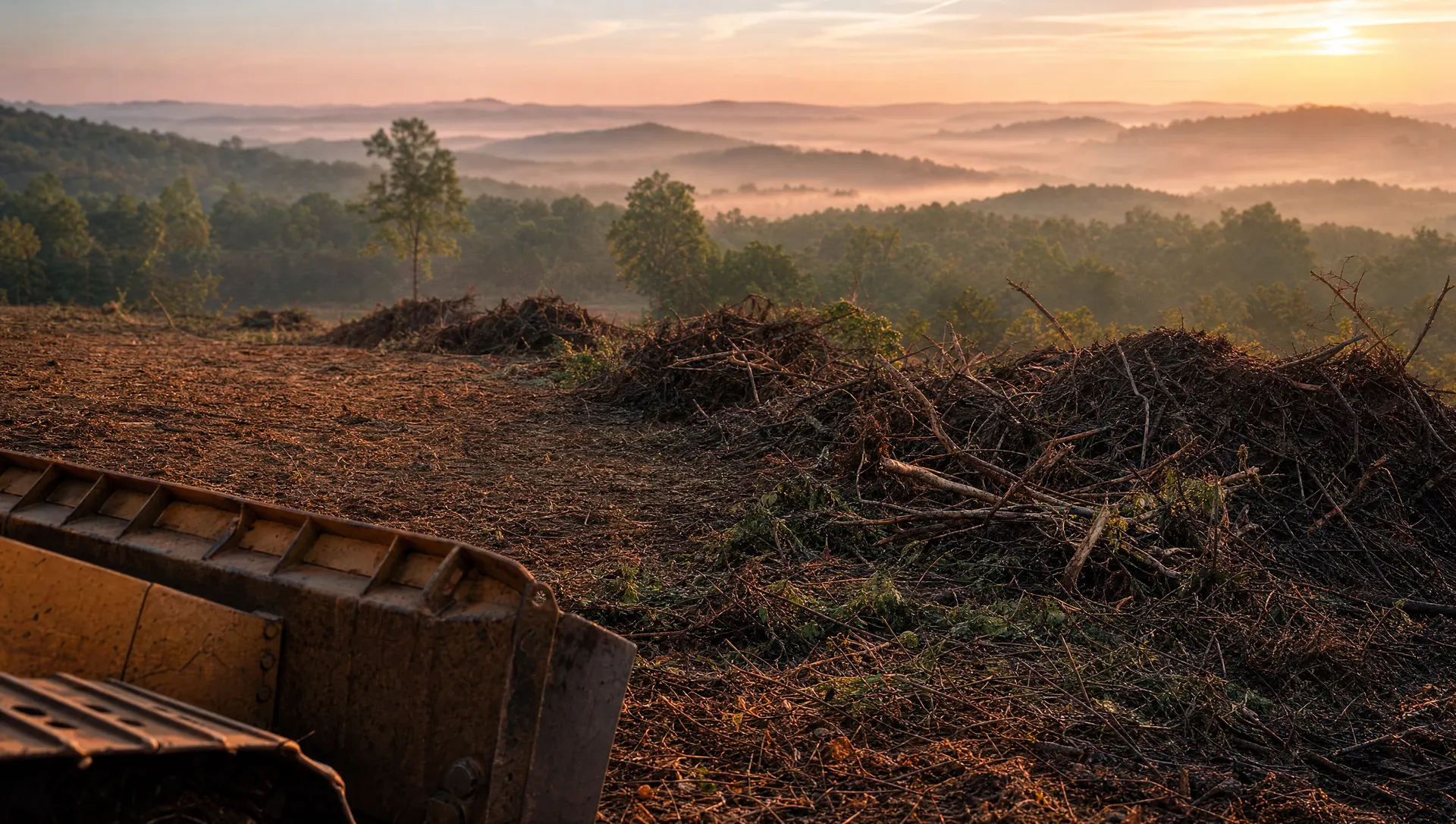
Land Clearing in West Plains, Missouri
Some properties around Howell County need a little brush knocked back. Others need everything gone — trees, cedar, brush, stumps — down to ground you can actually build on, fence, or plant. Land clearing covers that whole range, and West Plains Land Clearing works with property owners across the West Plains area to figure out exactly how much clearing a piece of ground actually needs before any equipment shows up.
Whether you're taking back pasture that's grown up in cedar over the years, opening up a wooded lot for a new home, or just trying to make a piece of property usable again, land clearing is the starting point.
What Land Clearing Includes
Land clearing isn't one fixed task — it's matched to what the ground needs:
- Removing standing brush, cedar, and small trees, either by mulching in place or by cutting and pushing
- Clearing larger trees where the site calls for open ground
- Grinding or pulling stumps when the ground needs to be root-free
- Handling debris — mulched, piled, burned where allowed, or hauled, depending on what you'd prefer
- Rough clearing of the ground ahead of seeding, fencing, or construction
A given job might use one of these steps or all of them, depending on whether you're reclaiming pasture, prepping a building site, or just trying to open up ground that hasn't been touched in years.
Land Clearing on Howell County Ground
This is Ozark hill country, and that shapes how land clearing actually plays out. A lot of properties around West Plains have some mix of slope, rock, and tree cover that changes from the road frontage back to the property line, so the plan for one part of a tract doesn't always match the plan for another part of the same tract.
Cedar is the recurring theme. Eastern red cedar spreads across untended pasture and glade ground steadily, and a lot of "wooded" acreage around Howell County is really old pasture that cedar has taken over a section at a time. Clearing that ground is often less about cutting a forest and more about pushing back an invasion that's been building for years.
This is also cattle country, so a good share of land clearing work here connects back to grazing — getting pasture back under grass, opening up a hay field, or clearing a fence line that's disappeared into brush. And with rural acreage around West Plains staying popular for new home sites, we clear plenty of wooded lots headed for a house, barn, or driveway instead of a pasture.
Access shapes a lot of these jobs too. A back pasture reached through two gates and a creek crossing takes more planning than a field that opens straight off the county road, and knowing what equipment can realistically reach a given spot — before a crew is scheduled — keeps a job from stalling out partway through.
When to Call for Land Clearing
A few signs it's time to get land clearing scoped out:
- Pasture that's visibly losing grazable acreage to cedar or brush each year
- A building lot that's still wooded or brushy with a house, barn, or driveway planned
- Fence lines that have disappeared into brush and brambles
- Property you're buying or inheriting that hasn't been maintained in years, and you want an honest read on what it will take to open back up
- Land you want to sell or list, where cleared, usable acreage shows better than an overgrown tract
What Land Clearing Costs
Cost typically comes down to three things: how much ground, how dense the growth is, and what condition you want the ground in afterward. An acre of scattered cedar and light brush mulched in place typically costs less than an acre of dense mixed growth cleared down to bare dirt with stumps pulled, simply because the second job moves more material and takes more time. Terrain adds or subtracts too — flat, open ground clears faster than steep or rocky sections. Access matters as well; a lot with a clear path in for equipment is a more straightforward job than a back corner of a property that's hard to reach. We walk the ground and give you a real number instead of a per-acre figure that doesn't account for what's actually growing there.
Debris handling factors into the number as well. Mulched material generally stays on-site as ground cover with little added cost, while a job that generates a large volume of pushed brush, trees, and root balls costs more once hauling or burning gets figured in. We walk through debris options as part of the quote, not as a surprise line item afterward.
How is land clearing different from lot clearing?
They overlap, but lot clearing usually refers specifically to prepping a building site — a defined area meant for a house pad, driveway, or septic field, cleared down to a buildable condition. Land clearing is the broader term and can mean anything from mulching a few acres of pasture brush to fully clearing a home site. If your project is specifically about prepping a construction site, our lot clearing for construction page covers that in more detail.
Do you clear land that's partly wooded and partly open?
Yes, and that's a common situation — a property with open pasture on one end and timber or brush encroaching from the tree line. We can scope the job to just the part that needs work, whether that's pushing back an advancing tree line, clearing a specific section for a new use, or handling the whole tract at once.
Can you work around wet-weather springs, ponds, or low ground?
Yes. A lot of Howell County properties have a spring, pond, or low, poorly drained corner somewhere on the tract, and those areas usually need a different plan than the rest of the property — sometimes clearing right up to the edge and stopping, sometimes leaving a buffer strip in place. Tell us about any wet ground or water features up front so they're part of the plan from the start, not a surprise once equipment is already out there.
Get a Free Quote on Your Land Clearing Project
Tell us what the property looks like now and what you're trying to get it to. We'll give you a straight, free quote on the clearing it actually needs.
Got Ground to Clear in Howell County?
Tell us about the acreage and we'll get back fast with a free, no-pressure quote.